

The Immortal MF DOOM
Certain Sips ☕ The Weekend Brew: October 12, 2025

Forgive me reader, for I have sinned.
I have used so-called artificial intelligence not once, not twice, but many times to edit my work and interrogate the premises on which my essays are based. I have justified the use of AI to others and to myself on the flimsy moral standing that I do not rely on it to write for me, but only to improve my writing. But I have known—and you should know—that is this is far from the only concern.
Lilly Dancyger called me to account in a July 10 post that I stumbled upon only yesterday. In Museum Pages: Botticelli, AI, and Missing the Point, Dancyger indicts AI use as a crime not just against artists, a free society, and the planet, but against the user:
“But if you don’t care that you’re speeding up climate change or stealing directly from your peers (yes, directly—if you use AI, I consider you someone who has stolen from me personally), or playing right into the techno-fascists’ hands, don’t you at least care that you’re also stealing from yourself?
In fact, what you’re stealing from yourself by using AI to ‘write’ is arguably even worse than what you’ve stolen from me and thousands of other artists: You’ve stolen our life’s work, but you’re stealing your own life. I mean that literally: You’re stealing your own emotional and intellectual and spiritual experience of being alive. And in the process, you are actively making yourself stupider, stealing your own ability to think. (And no, for fuck’s sake, using AI is not equivalent to using a calculator or a thesaurus, tools that were not built on theft, that don’t devastate the environment, and that don’t have strong penchants for blatant falsehood, contributing to our post-truth culture and all of its terrifying implications.)”
Maybe it was the last straw on a pile on AI critiques, maybe it was her appeal to my own self-interest. Either way, Dancyger shattered my position and caused me to deeply reexamine the implications of my AI use:
“‘Writers’ who use AI to come up with ideas for them, or to solve structural issues, or whatever other essential parts of the writing process they rationalize surrendering to an algorithm, are similarly skipping over the actual experience, trying to cut straight to the documentation. To the thing they can post online and be praised for. To the evidence of an experience they never actually had. And similarly, they are rendering the entire exercise meaningless and empty.”
Meaningless and empty. In an era with so much at stake, where endless avenues to meaning and fulfillment are at our fingertips, when we live with such precarity, what a corrosive tragedy to pursue and perpetuate experiences that are meaningless and empty. Last night as I read and reread Dancyger’s plea, I was listening to a song that has been haunting me all summer and into the fall. A song that embodies the sacred human art her essay reveres and demands we protect.
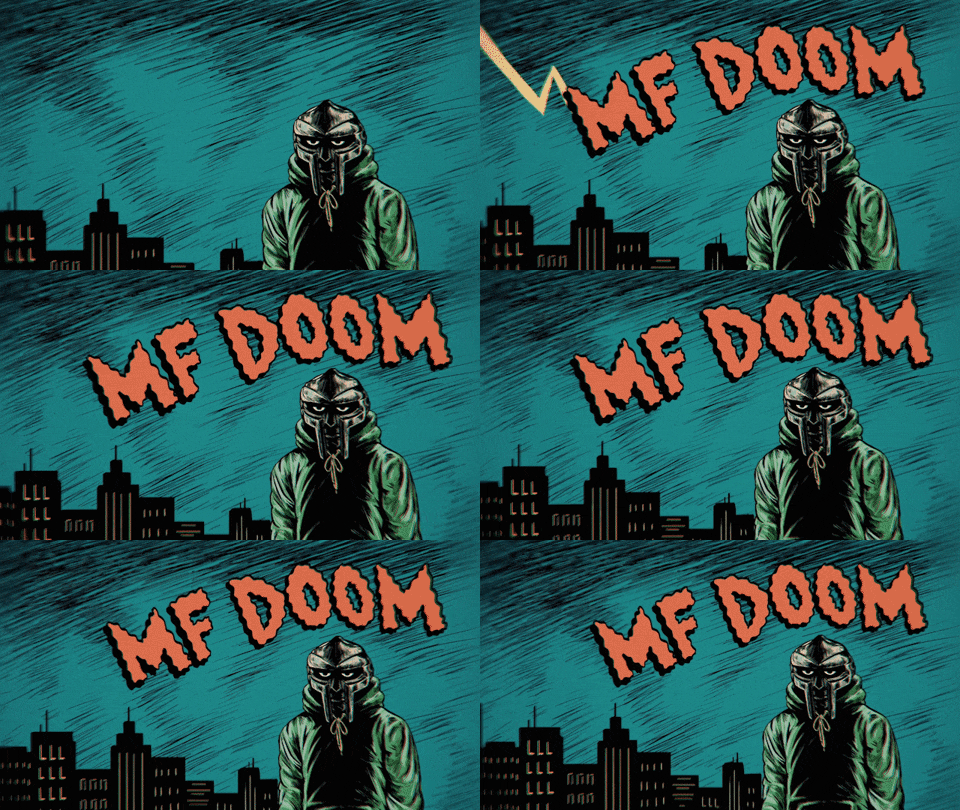
Belize by Black Thought (of the Roots) and Danger Mouse hypnotizes with a soulful sample of the psychedelic rock band Federal Duck’s Peace in My Mind. Once you’re involuntarily nodding your head, Black Thought spits a fiery first verse well worthy of praise. But MF DOOM’s gravelly second and final verse sharpens Belize from a great song to an immaculate all-time gem. It’s pure stream of consciousness, a style of rap so singular and influential that DOOM has been called a genius by Radiohead’s Thom Yorke and “your favorite rapper’s favorite rapper” by Q-Tip of Tribe Called Quest.
A stream of consciousness transcends the active brain, overtaking the mind and body to channel some deep, insuppressible thought into words. Some writers never experience it; others are lucky to occasionally find themselves in submission to such a powerful flow state. The stream of consciousness is diametrically opposed to building things with AI; it is a rare product of the soul that contracts when one outsources to AI the strength-building exercise of powering through the challenges of excellent craftsmanship.
Belize, MF DOOM’s full discography, and his influential legacy endure as testaments to work we must do not only in service to others, but to our deeper selves. To the disciplines and principles we must follow if the act of creation—even in solitude—will ultimately fill us up or leave us hollow. DOOM died on Halloween 2020, a cruelly poetic departure date for an artist defined by his iconic metallic facemask. He never appeared in public without it, he refused pictures without it, and he lived out a full identity showcasing its layers of dark symbolism. MF DOOM was the mask, and the mask was a totem of creative expression. Real, human expression born from blood and bone.
Five years after the death of DOOM, the techno-fascists have transformed the mask into a symbol of totalitarian state terror. When will we be able to fully reclaim the mask as a free people’s safeguard and artistic emblem? As we approach Halloween 2025, what does it mean to step outside ourselves, to cover ourselves, to live one day as the superhero we might wish to be? Or the supervillain? As we’re ever so tempted to sacrifice our souls at the altar of advanced technology, what does it mean to play dance with death?
Belize may be a reference to the TV show Breaking Bad, wherein killing someone is coded as “sending them to Belize.” It may also be a safe and cloistered destination for someone who needed an escape from the toxic music industry and the streets of New York on which he once slept. Finally, Belize may be a coastal paradise easily mistaken for some kind of heaven on earth. If anyone deserved eternal life in a stress-free pleasure province, it’s MF Doom. I don’t believe in heaven, but that doesn’t mean it doesn’t exist.
