

One Battle After Another: Everyone Weighs In.
A roundtable discussion about Paul Thomas Anderson's sensational tenth feature film


Since its September release, One Battle After Another has piled up box office receipts and rave reviews. The gang got together to discuss this epic Paul Thomas Anderson adaptation of the 1990 Thomas Pynchon novel Vineland.
**SPOILER ALERT**
says:
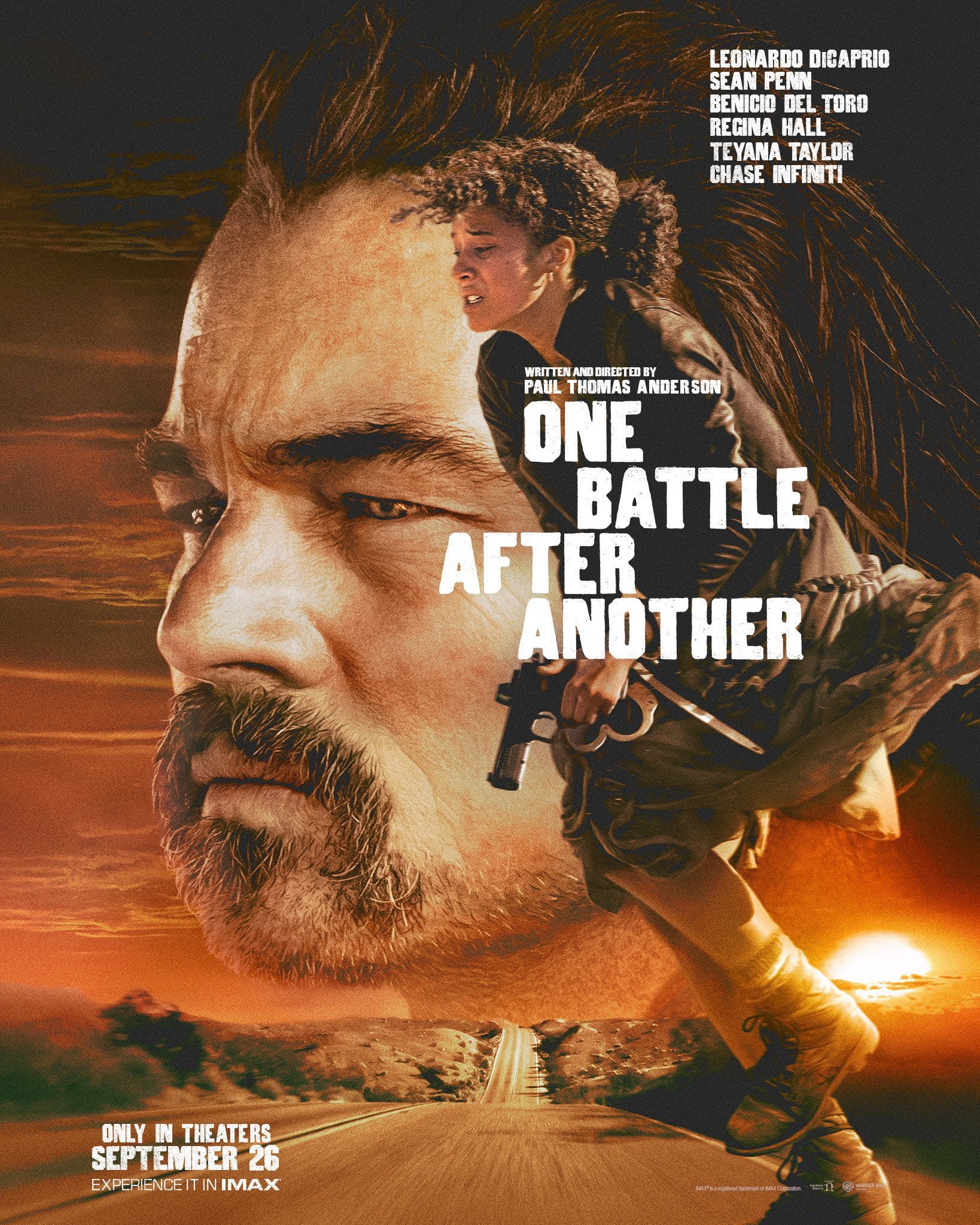
It is easy to forget, when considering his affinity for a masterfully executed period piece, just how firmly Paul Thomas Anderson keeps his finger on the pulse. One Battle After Another violently plants us in the present. This violence, distinctly American in its nature, ricochets throughout the film, conjuring with it my own memories of mandated curfews, tear gas and flash grenades, a rogue semi-truck nearly leveling a crowd of protesters on the I-35W bridge, nails placed in the road to pop the tires of resistance groups, the military deployed against US citizens by the sitting President—all following the image of a despicable pig crushing the neck of a Black man under the weight of his knee.
I recall the swift and vicious derailment of truth following George Floyd’s murder, the narratives peddled not only by far right grifters, but also the mainstream local media. These false narratives only served to justify and protect state-sanctioned brutality. In OBAA, we see a line drawn between abject violence enacted by the state and the necessary force of resistance, an all too important distinction during an age in which the average American can barely define the ubiquitous phrase “political violence.”
Colonel Lockjaw, the film’s principal villain, becomes an emblem of this country’s vacant soul. He kills people on a lark. He uses the full power of the state flippantly for his own wishes. He siphons power from a Black woman, then imprisons and degrades her. He passionately eviscerates without cause; his identity remains empty. Here is a film about the crisis of white American identity, the same crisis bell hooks wrote about in 1992, still plaguing us with its vapidity and listlessness. Perfidia (performed by the indomitable Teyana Taylor) dominates the screen and transfixes both Leonardo DiCaprio’s Bob and Sean Penn’s Lockjaw. While Lockjaw’s relationship with Perfidia more explicitly displays the hatred inherent in fetishization of Blackness, PTA does not allow Bob to escape unscathed by criticism. One might call Bob’s part in the revolution middling, defined mostly by his proximity to Perfidia. He finds himself enthralled by her stark independence but devastatingly less adept at leading; his contributions represent a weak yet common iteration of racial solidarity, especially from the white left. But the film does not let its gaze rest here.
What I find so compelling about this singular film is Paul Thomas Anderson’s ability to expose our current obstacles for what they are without descending into the ensnarement of nihilism. The state, ICE, modern day Nazism, hollowed out whiteness, indifference: these are our enemies. One Battle After Another invites us into imperfect, scrappy rebellion. With sophistication, it interrogates our pitfalls, our lack. Yes, it’s a movie from a wunderkind director who lives largely divorced from the reality of the average American. It’s Hollywood. But it’s one of the most impressive things to come out of Hollywood this decade. A salve for disillusionment, a beautifully rendered, ambitious film.
says:
There are three distinct portrayals of Christianity in One Battle After Another—and in 2025, that’s important. Director Paul Thomas Anderson has played with themes of Christianity more than a little bit in his career, in There Will Be Blood, Magnolia, and The Master. I’m sure he’s peppered more into other films as well. Each of those pieces have been historic or personal in their portrayals, while OBAA shows it to be something incredibly (and increasingly) political.
We first see its presence in a frame lingering on a subtle crucifix necklace on Perfidia’s mother. Later on, children’s crayon drawings of both Mary and crosses are kept within focus while federal agents rip apart a Hispanic immigrant community. Children’s cries echo down the halls of the scene. (Just last weekend, actual ICE goons arrested 37 people and separated American children from their families—families and children I presume are primarily Catholic.)
Meanwhile the “Christmas Adventurers Club,” a WASP-y billionaire boys deep-state stand-in, prays to Saint Nicholas and stresses the importance of a White Christian ethnostate. The rich men’s warped idea of Christianity evokes real-life supervillain Peter Thiel’s obsession with the antichrist, and other Silicon Valley billionaires’ aspirations to create the ‘second coming’ in the form of artificial general intelligence. An offensive, inhuman Christianity directly at odds with the immigrants’ defensive Christianity.
Scenes in active or repurposed churches fully expose the film as religious text. The Sisters of the Brave Beaver cut themselves off from society rather than seeking to move under its floorboards or rule over nations. They’re refugees in their own right, but armed as radical insurgents. While the ‘immigrant’ and the ‘oppressor’ Christian are still visible to us in the real world, along with their fight, I do wonder where the true religious ‘radical’ is. I’m sure Paul Thomas Anderson is asking the same.
says:
I’ve been wanting to rewatch One Battle After Another to further develop my feelings, especially since towards the end of the film, the runtime had started to wear on my bladder, the contents of which consisted of two (2) IPA tallboys sold by the theater concessions counter. It is an unfortunate aspect of modern moviegoing that the lengthening of runtimes has coincided with the rise in availability and quality of beer at most theaters.
Anyway, OBAA is an impeccable piece of filmmaking, somehow combining elements of two of my other favorite films, both by the Coen Brothers: The Big Lebowski‘s comedy derived from seeing a lovable, chemically-altered loser in over his head and No Country for Old Men’s armrest-shredding tension. Politically speaking, I couldn’t help but notice the weird dissonance in applying what seemed to be bog-standard liberal politics (e.g., legal abortion and racial egalitarianism) to the Maoist aesthetics and tactics inherited from the guerrilla groups in Pynchon’s original novel. Maybe this was prescient though, since the current administration is essentially declaring supporters of bog-standard liberal politics to be domestic terrorists. Viva las Madres de Vino.
says:
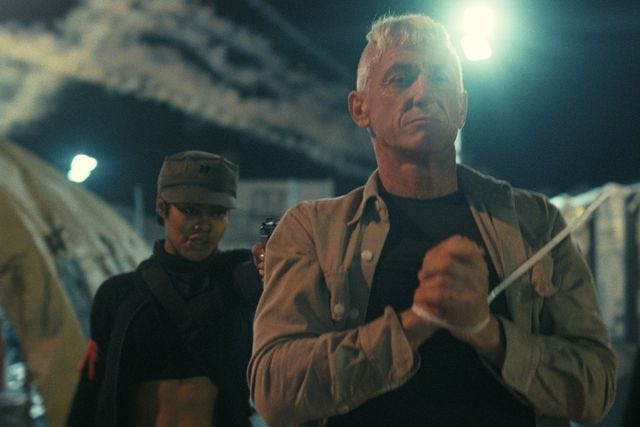
Vineland was an interesting and textured read that was well adapted by Paul Thomas Anderson, even if there were certain elements that never would’ve been translatable on film and other relatively minor quibbles I might have with it.
One aspect I enjoyed in Vineland—but don’t blame PTA at all for excluding from the adaptation—is the Thanatoids. Initially described almost like a cult, setting up camps outside of towns and such, you begin to realize over the course of the book that these people aren’t quite alive. I don’t think they’re ever explicitly referred to as ghosts or shades but for one instance, and some of the living characters do interact with them and mention them, but they are definitely not one hundred percent of the living.
Pynchon’s novel also emphasizes TV addiction, illustrating how TV is addictive and makes people unsure of what reality actually is, which seems like it could have been a ripe vein to mine given our ongoing fascist movement. There was less information about how the media landscape fueled or gave birth to the reactionary movement in the movie than there was in the novel, which made it feel a little flatter than it otherwise could have. The fascist movement we see onscreen seems relatively all-powerful and already in control of most of the media. The French 75 seem to be the ones focused on spectacle, rather than the (mostly) hyper efficient government goons. Leonardo DiCaprio’s character getting into his divorced dad era on social media is the only real reference we get about the information environment.
The adaptation also shed a major arc from the novel, Prairie Wheeler (Willa Ferguson in OBAA) searching for her mother Frenesi (Perfidia Beverly Hills). While an interesting character in her own right, Willa is mostly dragged along by other characters and seems to lack the agency her analogue had in the novel. This is somewhat similar to the novel where she is accompanied to the ninja nun convent by a badass assassin, but in the book, she’s portrayed in a much richer manner with more of her wants and desires than we see demonstrated in the movie—the role of her mother in her life, beyond just that of an absentee snitch, is far more important.
I inadvertently bought tickets to the 4DX experience at the theater. It added an interesting layer to the movie, with seats shaking during explosions, smoke machines, flashing lights, and puffs of air accompanying gunshots on screen. It also poked me in the back during the pegging scene. The book will almost always be better than the movie, but in fairness to PTA there was no simulated pseudo-pegging while reading the book. [Read ’s full thoughts here.]
says:
Film is rarely revolutionary, in the sense that you might trace its consumption to future action. But maybe we don’t need it to be revolutionary right now? Maybe we can start smaller. In a post-reality media landscape with no distinguishable mass culture, any art that breaks through the swarm of surreal and hyperreal has an opportunity to hold up a mirror. Art critics bemoan the reluctance to capture life lived through the phone, but OBAA’s strengths are in its willingness to reach through the screen. It’s relatable!
The film rolls out a dozen or more characters and plot points that we’ve all known in REAL life, for better and worse. Despite the baked-in absurdism of any attempt to adapt Thomas Pynchon, the phenomenal acting by Chase Infiniti, Leo DiCaprio, Regina Hall, and especially Benito Del Toro humanizes this film in a way that did not emerge from the equally-great cast of Anderson’s other Pynchon adaptation Inherent Vice.
This is not to say it’s all lived-in. Cartoonish acting by Sean Penn and some on-the-nose dialogue remind you to laugh at it all. But the too-online jabs at Twitter leftists and fascist caricatures are perfect foils for the key wager of the film: what one is willing to risk for who and what they love, imperfections and all. This is a skin-in-the-game film for an audience yearning for it. This film almost certainly won’t spark the revolution, but if it can convince even a small portion of its already massive audience that the revolution will not in fact be televised, then it will earn its place as one of the most influential films of the past decade.
says:
Ari Aster’s Eddington (2025) shows that activist libidinalism is not a substitute for a working-class movement. Never has been, never will. If radlib spectacle worked we’d be in a not-fascist country right now. And in Eddington, we see those useless to counterproductive libidinal energy diversions are being facilitated, amplified, and gamified by social media and its data centers so no real movement can emerge—only spectacle and backlash.
It’s a far superior movie to the libbed-up OBAA, in which the libidinal is served up as corny literal horniness, reduced to individual sexual fetish/obsession instead of examining the degree to which the propaganda of the deed is a libidinal release that can derail mass action instead of inspiring it. That said, OBAA’s Sensei subplot showed how real, long-term action manifests itself and creates self-sustaining community buy-in and potentially building class solidarity, as opposed to spectacular one-off stunts like freeing the migrants (still a good end, but impossible to duplicate).
I don’t think OBAA is a bad movie at all; it has a lot of great parts, and it is an explicitly anti-fascist movie. I just think it’s a movie that has no articulated belief in class politics, only identity politics, but still has anti-fascist bonafides within a United Front framework. Tl;dr: Eddington: socialist auteur, horror movie, historical materialist irony. OBAA: lib auteur, comedy-action thriller, confused class politics subsumed to identity politics that potentially still supports exploitation as long as it is lawful and not racialized.
says:
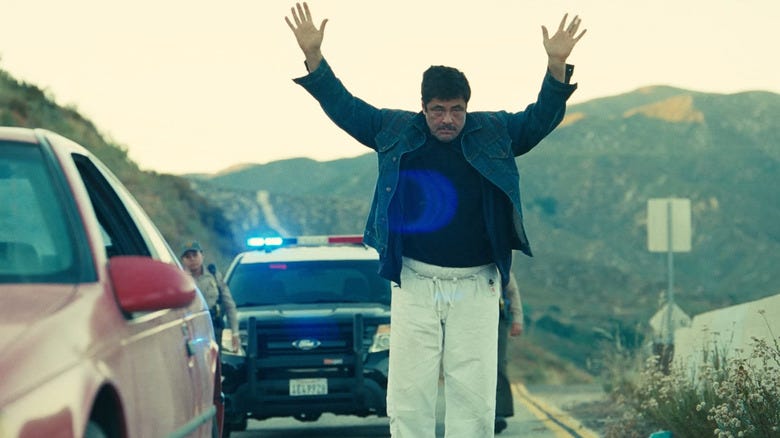
In 2007, as the War on Terror sank further into bloody quagmire and a second Great Depression reared its head, movie goers were blessed with two would-be classics (three actually, but for now let’s set aside Michael Clayton): Paul Thomas Anderson’s There Will Be Blood and the Coen Brother’s No Country for Old Men. Both movies confronted the rapaciousness and callousness and rot that had been exposed as foundations of American imperialism through the true American genre: the western. However instead of showing how a dashing cowboy or gunslinger conquering the evil lurking in the frontier, PTA and the Coens showed an American frontier consumed and fueled by violence and greed,
And audiences couldn’t get enough. The two movies raked in a more than $250 million at the box office and were nominated for a combined 16 Academy Awards, of which they won two. As everything fell apart, the neo-western had never been better.
Now eighteen years later, things are once again falling apart. The scotch tape used to try and reinforce America’s rotting neoliberal foundations after 2007 have proved unable to hold up. Dumb-guy fascism threatens to destroy our already disfigured democracy. Federalized thugs roam American streets hunting down people of color like modern day slave catchers. Social media companies in search of dwindling growth opportunities unleash perverse algorithms on their increasingly schizophrenic users.
And once again, the neo-western has never been better. As neoliberalism’s collapse reaches its climax, it’s unsurprising that the two best movies this year are set in the American West. One Battle After Another (another PTA instant classic) and Eddington (directed by Ari Aster) portray the pervasive feeling of political powerlessness at the end of the American century, both set against the desolate and isolating landscape of the frontier. In each movie the American West, once the birthplace of our national myth, now finds itself ground zero of that myth’s violent collapse.
As good as these films are, I personally hope this is the last year of the great neo-western. No other genre better showcases America’s still dominant violent id. If we are able to truly reckon with that id and excise it from our psyche maybe we’ll lose a couple classics every decade. It will be a small price to pay to bring an end to all of this shit.
says:
You know what rocks? When you have high expectations for something and it delivers. I wanted to go see some woke violent P.T. Anderson shit, but I got woke violent PTA shit that rocked, multiple scenes that gave me No Country for Old Men vibes, AND Teyana Taylor doing Teyana Taylor things. 9.8/10
says:
I have a lot to process still, but the part of the movie that left the biggest emotional impression on me right from the rip has been the themes of grappling with the long-term reality of dedicating your life to a cause and seeing that torch get passed to new generations. As someone who made the choice to dedicate my career to being a public defender, reading “16 years later” and seeing the exact same damn problems rotting society got a “yep” from me. But as a father-to-be with a child coming in three months, this movie presented me with a question I had never thought of yet: what happens when my child decides to try to make their mark on the world too? To take up the “family business?”
I’ve already given a lot of thought to the decision that my passion for my career will take a backseat to parenthood—and made my peace with it—but what happens in 18 years if my child wants to dedicate their own life to a cause? Isn’t that what I want for them? Would they be safe? Would they become jaded too? Would they choose their righteousness over their potential family, like Perfidia Beverly Hills did? *Is that wrong*? I found the film’s decision to raise those questions, from the parent’s perspective, totally unique and provocative.
says:
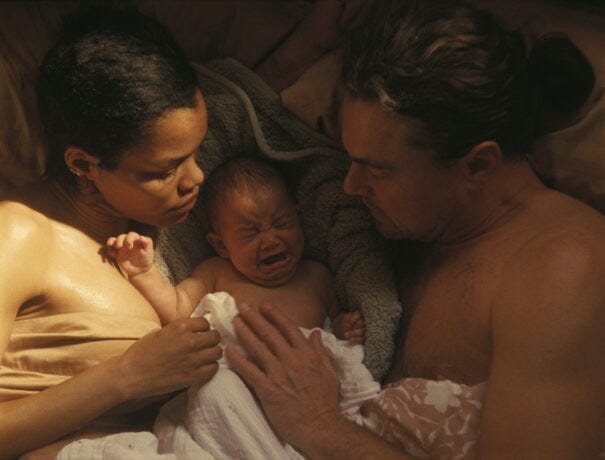
Very solid film. I watched it twice in a row—opening night and the day after that—because I got such a rush after seeing it the first time. Sean Penn and Leonardo DiCaprio’s characters made for some hilarious moments. DiCaprio has great chemistry with Benicio del Toro, who plays his onscreen daughter’s (a compelling Chase Infiniti) karate teacher. Teyana Taylor was electric; I wish she had more screen time. This was my first PTA, so I was pleasantly surprised by how different it was from the standard action movie fare I was expecting, both in tone and timeliness. Needless to say I will be checking out his filmography and looking forward to watching whatever he’s planned next!
says:
I hate Perfidia Beverly Hills. And I hate this movie for making me hate her. The first time I saw One Battle After Another, I didn’t like it nearly as much as everyone else—but couldn’t really figure why. So I saw it again in the hopes I might enjoy it more, or at least better understand why not. The rewatch sparked a visceral disdain from the very first scene, vindicated by Perfidia’s subsequent abandonment and betrayal, cemented by her cringe-worthy and self-obsessed epilogue. Colonel Stephen J. Lockjaw isn’t the villain of this film. Perfidia Beverly Hills is.
Paul Thomas Anderson paints Black revolutionaries as sex-crazed, unserious, and incompetent. As exemplified by Perfidia Beverly Hills, the insurgent French 75’s endemic narcissism and cowardice overshadow any sense of strategy or discipline. Perfidia’s traitorous affair undermines everything she’s fighting for and dooms everyone in her orbit, including her unborn child. Everyone’s a rat. Everyone’s weak. Black pussy power is not used to liberate or love, but to corrupt and demean the movement.
Freedom-loving Gen Xers and Millennials are failed parents and rebels alike; only Gen Z offers us a glimpse of hope for an anti-authoritarian future but even there the cracks are already beginning to show. The Christmas Adventurers Club are played for laughs, but their power is immense and unchecked. They are exceedingly, devastatingly competent. Meanwhile the rebels are presented earnestly, but they are the real joke—to all of our grave expense.
If I can commend Paul Thomas Anderson for anything, it is his mastery of the medium and an ambitious attempt at a political action thriller told through his signature device of a large ensemble of characters. But the large ensemble magic only works when each of those characters are fully developed and sympathetic, if deeply flawed. OBAA is at times beautiful and breathtaking, but ultimately underwhelming and plainly offensive in its depiction of its protagonists. We’ve stumbled pretty far from Boogie Nights.

Previously, on Certain Thoughts:
AOC 2028? Everyone Weighs In.

Who is more exciting than AOC? Although she has not announced for President in 2028, speculation abounds.
Walz 2028? Everyone Weighs In.

Minnesota Governor Tim Walz has generated considerable attention recently, sparking discussion about a potential Presidential candidacy in 2028.
Bernie 2028? Everyone Weighs In

Coming up second in 2016 and 2020, Sanders remains the most popular Democrat never nominated for President. As he raises millions mobilizing against oligarchy, we ask: Bernie 2028?
 | A guest post by
|
 | A guest post by
|
 | A guest post by
|
 | A guest post by
|
 |
|
 | A guest post by
|
 | A guest post by
|
 |
|
 | A guest post by
|
 | A guest post by
|
My quick take is any movie explicitly showing ICE/DHS and the white nationalist clowns who run it as the pathetic, petty, sadistic control-freaks they are is good and I don’t mind this movie deploying humor to achieve that.
I’m so very curious to see what the disconnect is between almost all these beautifully written reviews; but two. I find it entertaining to read conflicting perspectives in reviews prior to watching a film and considering throughout each of those people’s opinions. In a weird way, it connects me much more to a film!
I’ll comment on this after I see it with my guesses vs. actualities..